


The rails are getting faster — where money movement is heading
CentryOS
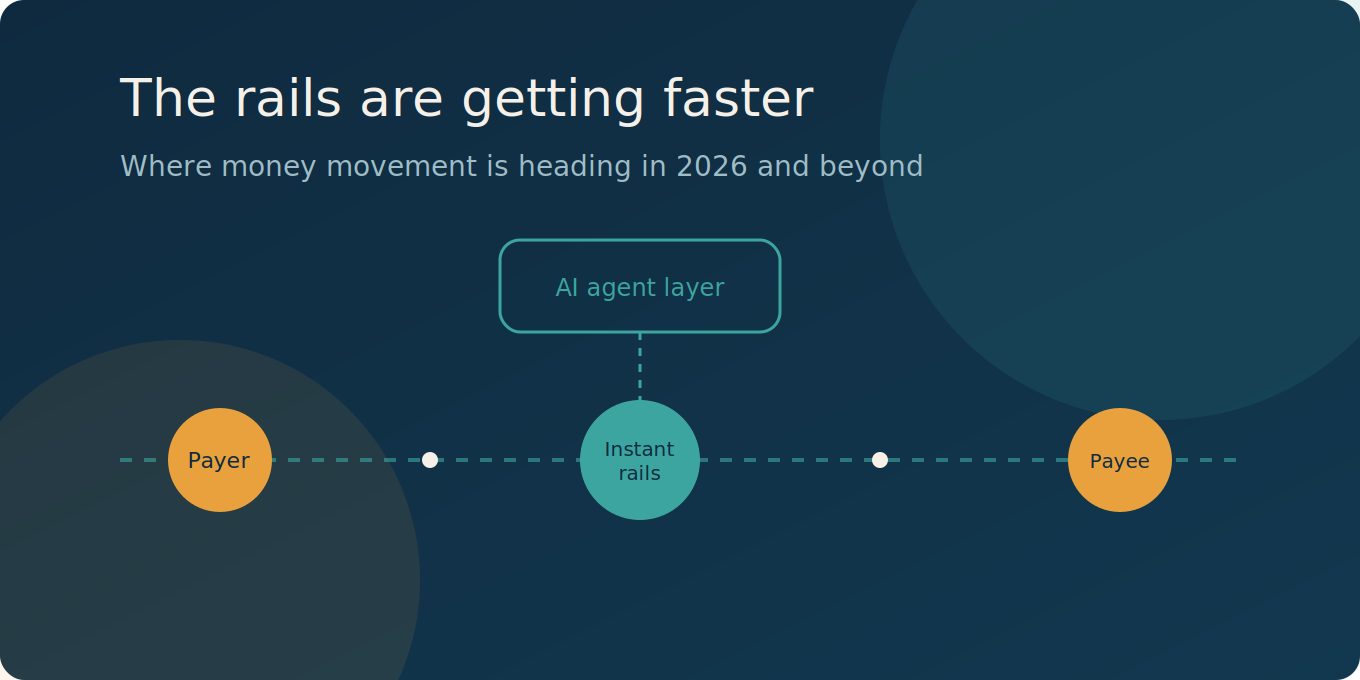
The Rails Are Getting Faster
Five shifts reshaping how money moves — and what they mean for anyone building on top of payments.
Published — July 2026
Payments has always been a slow-moving industry hiding behind a fast-moving interface. The tap feels instant; the money underneath takes days. That gap is finally closing, and the changes arriving now are structural rather than cosmetic. Here are the shifts worth paying attention to.
1. Instant is becoming the default, not the premium
For most of the last decade, "real-time payments" meant a surcharge or a special product. That framing is inverting. With account-to-account rails maturing across major markets — FedNow and RTP in the US, and their equivalents elsewhere — instant settlement is quietly becoming the expected baseline.
The implication for builders is significant: business logic that assumed a multi-day settlement window (holds, provisional credits, batch reconciliation) starts to look like technical debt. Systems designed around "the money will arrive eventually" have to be rebuilt around "the money is already here."
2. Account-to-account is pressuring the card networks
Card rails are convenient, ubiquitous, and expensive. As A2A payments get faster and easier to initiate, merchants — especially in high-volume, thin-margin categories — are actively looking for ways to route around interchange fees.
This won't kill cards. Cards carry consumer protections, rewards, and habits that A2A doesn't replicate overnight. But the pressure is real, and it's pushing the whole ecosystem toward giving merchants genuine choice in how a payment is routed. Expect more orchestration layers that decide, per transaction, which rail is cheapest and most reliable.
3. Orchestration is eating the payment stack
A few years ago, a company picked a processor and lived with it. Today, sophisticated operators treat processors as interchangeable and put a routing layer on top — one that can shift volume between providers based on cost, approval rates, geography, and uptime.
The strategic value is moving up a level: away from "which processor" and toward "how intelligently do I route." This is a resilience play as much as a cost play. When one acquirer has an outage or tightens its risk appetite, an orchestrated stack reroutes instead of going dark.
4. Agentic payments are arriving
The most genuinely new development: software agents that don't just recommend a purchase but execute it. As AI systems take on more end-to-end tasks, they increasingly need to move money — subscribing, topping up, purchasing, settling — without a human clicking a button each time.
This raises hard questions the industry is only beginning to answer. How does an agent prove it has authority to spend? What are the limits, and who sets them? How do you build audit trails and revocation into a flow where the "user" is a piece of software acting on someone's behalf? The winners here will be the platforms that make agent-initiated payments safe by default, not just possible.
5. Stablecoins are quietly becoming infrastructure
The loud phase of crypto is over; the useful phase is starting. Regulated stablecoins are finding a real job as settlement infrastructure — especially for cross-border movement, where traditional correspondent banking is slow and opaque.
For most end users this will be invisible. They'll never know a payment was settled over a stablecoin rail any more than they know which fiber cable carried their video call. But underneath, it changes the economics of moving value across borders, and it gives builders a programmable settlement layer that traditional rails don't offer.
The through-line
Every one of these shifts points the same direction: money is becoming faster, more programmable, and more contested at the routing layer. The moat is no longer owning a rail — it's being smart about which rail to use, when, and on whose behalf.
For anyone building in this space, the mandate is clear. Assume settlement is instant. Assume routing is a decision, not a default. Assume some of your "users" will be software. Build for that world now, because it's arriving faster than the roadmaps admit.
Building on modern payment infrastructure? These shifts are worth designing around today.